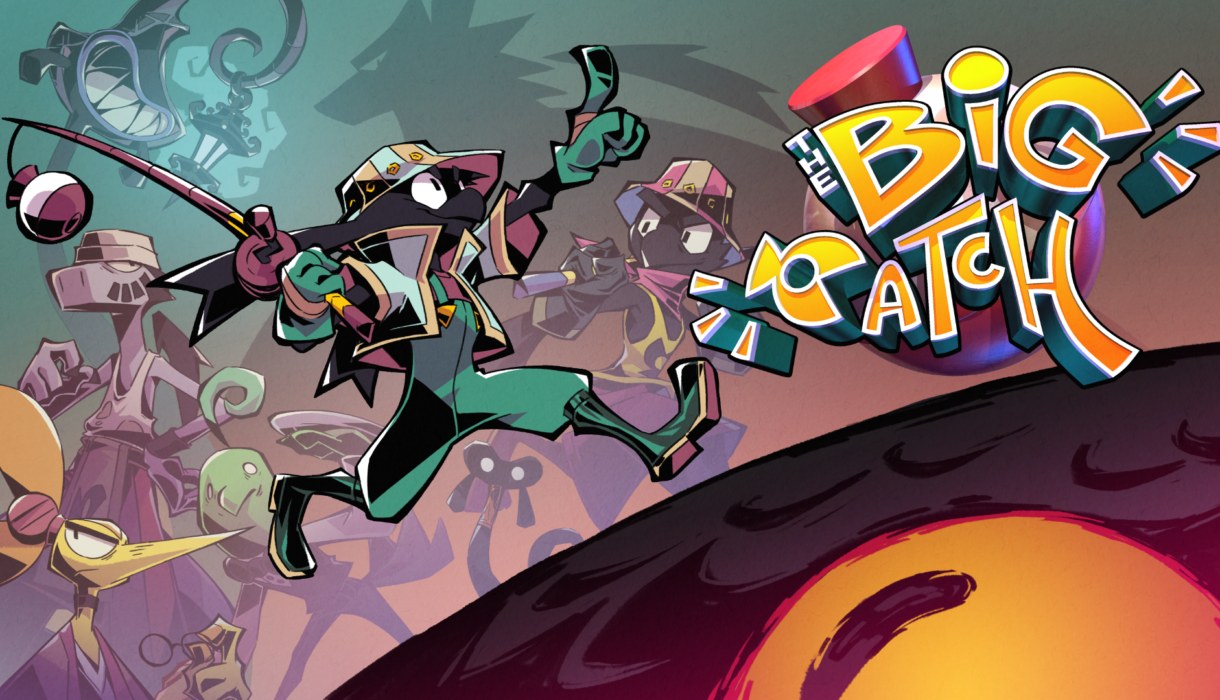

To call The Big Catch: Tacklebox a demo is to do it a grave disservice. Despite being free, it feels more complete than many full price games, and in my opinion it deserves to be evaluated as a standalone work – it more than holds up under such a lens, and in light of the fact that its content is fully separate from that of the full game I’ve decided to review it as such.
Most “N64 revival” indie platformers follow a very specific formula: a whimsical and colorful aesthetic, upbeat and energetic music, clearly signposted objectives, and segmented levels that may be individually open-ended but which are rigid in how you progress between them. This is how many classics of the genre operated, and based on this game’s title and the design of its main character, I assumed it would operate similarly. Instead, I was pleasantly surprised to find that its atmosphere, style, and structure are actually fairly original; Tacklebox goes for a very reserved color palette, a more atmospheric and mysterious soundtrack, and a completely open-ended world design that refuses to guide you to its objectives beyond a vague compass that pulses brighter the closer you get to one.
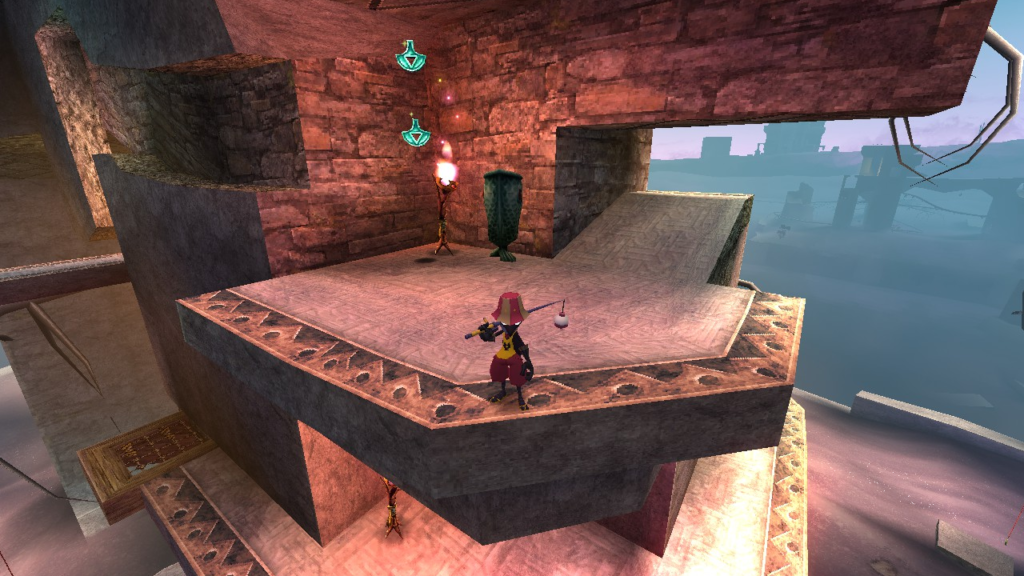
All of these decisions compound to make Tacklebox feel strikingly distinct from its ilk in ways that I find intensely compelling. The more subdued aesthetic style, the lack of a heavy-handed focus on objectives, and the freeform nature of the world all serve to put a laser-like focus on the game’s exploration and movement, which are fantastic and just as novel as everything else about the game.
Many 3D platformers load up their main characters with tons of distinct moves and tricks to fit different scenarios. There’s nothing wrong with this approach, but The Big Catch chooses instead to focus on packing a ton of nuance into each move and asking you to understand and utilize that nuance in precise ways. The tools themselves aren’t especially powerful; while you have a dash jump, a floaty spin jump, and a backflip, these moves don’t provide nearly as much height or distance as their equivalents in a game like Super Mario Odyssey, and the signature wall run doesn’t provide any upwards momentum at all upon initiating it – you have to get that upwards momentum yourself. The way you do this is by interacting with the environment and understanding how the game’s physics and momentum work.
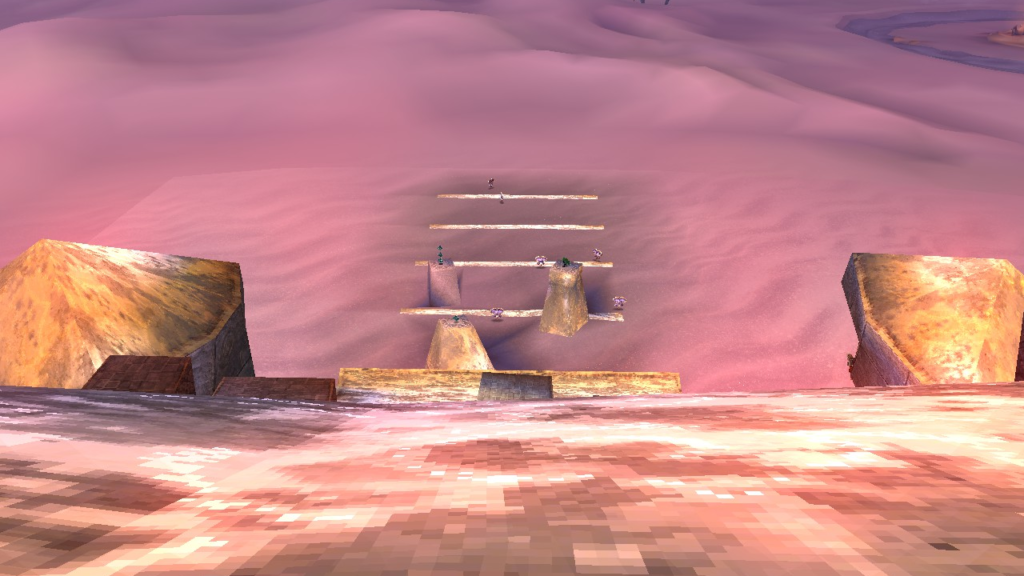
As an example, you might swing off of a pole to get a burst of speed with which to start a wallrun before being asked to jump off the wall and grapple from a precise angle and distance to reach a ledge. Alternatively, you might be expected to slide down an incline to build up the right amount of speed before hitting a ramp to launch off of it and land on a distant platform. You have a degree of control in the air, which can be increased by twirling the left stick to spin, but the bulk of your movement centers around the longer-term consequences of precisely how and where you use your tools relative to the environment, rather than chaining crazy sequences of moves together in quick succession.
Partly as a result of this, it’s not always immediately clear how you’re meant to progress. The effects of your moves can change dramatically based on the state of your character when you use them, and the levels are often designed in such a way that you’re expected to work out these interactions on your own. Tacklebox really provides very little in the way of guidance and it demands experimentation and critical thinking to complete it.
This can be a bit of a double-edged sword, though. After a very brief and not at all comprehensive tutorial section, you’re free to explore the world at your own pace and it’s easy to stumble across some of the game’s more obtuse challenges pretty early on, which can be discouraging. I had a little trouble getting into the game initially because I didn’t fully understand what it was asking of me, and this brings me to one of the game’s few flaws – it can sometimes be a little restrictive in how you’re allowed to approach challenges until you gain almost speedrunner-tier levels of skill.
To an extent, a result like this is inevitable from a game that aspires to be this challenging – if you give the player too much freedom of approach, you run the risk of allowing them to succeed with little effort. There’s a balance to be struck, though. Tacklebox sometimes finds it, providing several possible approaches each requiring precision and ingenuity, but often it comes down to finding the one specific solution and executing it correctly. That’s not always a bad thing; the occasionally puzzle-esque nature of its platforming added a really nice sense of mystery to my early exploration as I wondered how to reach certain places I could see, but I do think Tacklebox could benefit from being a bit less restrictive on balance.
The only other real complaint I have is that the game locks its final challenge level behind collecting every single coin (and by extension, fish) in the game. This sounds fine on paper, because the coins are interesting to find and collect – they’re often placed in challenging locations off the beaten path – but in practice there are just so many of them hidden around the gigantic map that the late-game sweep you’re likely to have to do (if your approach to the game is anything like mine) gets pretty tedious pretty fast. It’s not a dealbreaker, though, and the finale itself is a thoroughly worthwhile level that I enjoyed finishing.
It’s exceedingly rare for a platformer to hook me as much as Tacklebox did, and while I’m decidedly looking forward to the full game, there’s a part of me that wonders if I won’t come away liking Tacklebox more. I worry that the elements that make it so fresh and uniquely compelling to me won’t all carry over, that its status as a demo is why it stresses its mechanics so intensely and ignores traditional notions of tutorialization, and moreover allows for a more experimental structure that might not be what fans of the genre have come to expect. Even if that ends up being the case, though, I can’t be too upset because Tacklebox stands confidently on its own as an absolute gem and a brilliant work of art. It’s one of my favorite platformers as is, and I really can’t recommend it enough.