
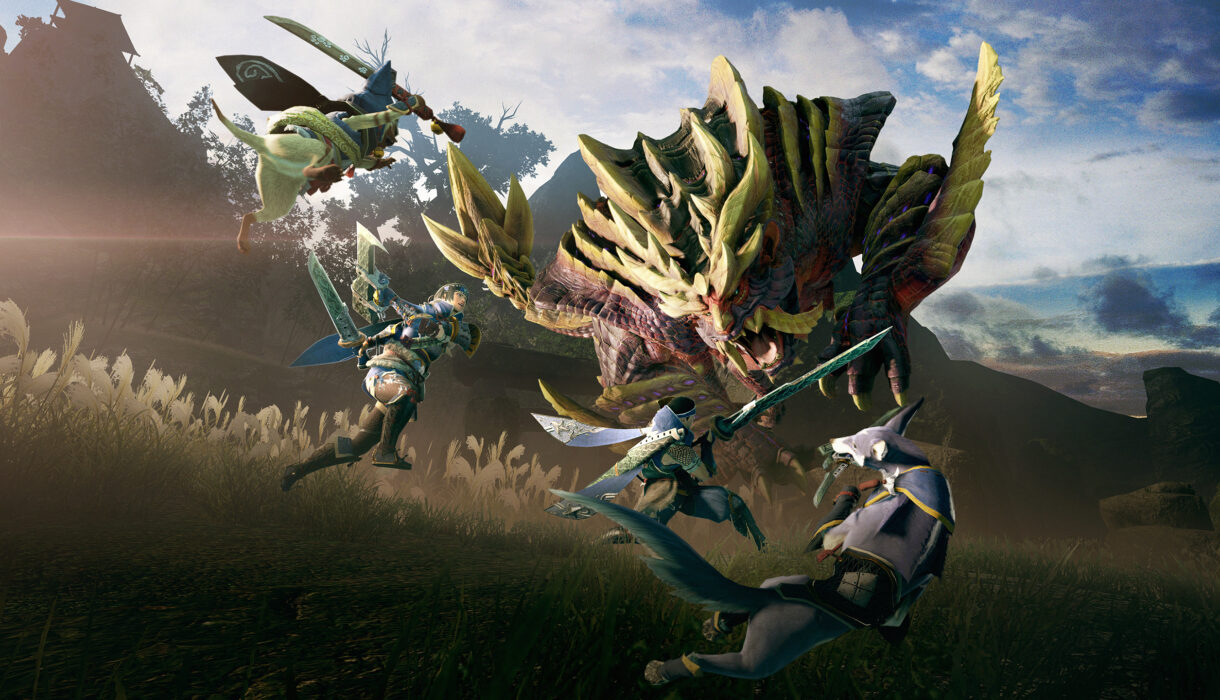

If you’re the kind of person who wants to get into Monster Hunter but has always struggled to, I recommend you start here. Rise was not my first Monster Hunter game – if we get really technical, it wasn’t even my second – but it was the first one that really clicked with me, and it enabled me to appreciate and enjoy the series as a whole. I know more than one other person who’s had a similar experience, and all of us ended up huge Monster Hunter fans when all was said and done.
It’s worth mentioning that at the time of this writing, I have not completed the expansion, Sunbreak. As such, this review only pertains to the base game, though I played it recently enough that no major updates to the base game have been made in the intervening time, so it should be entirely up to date.
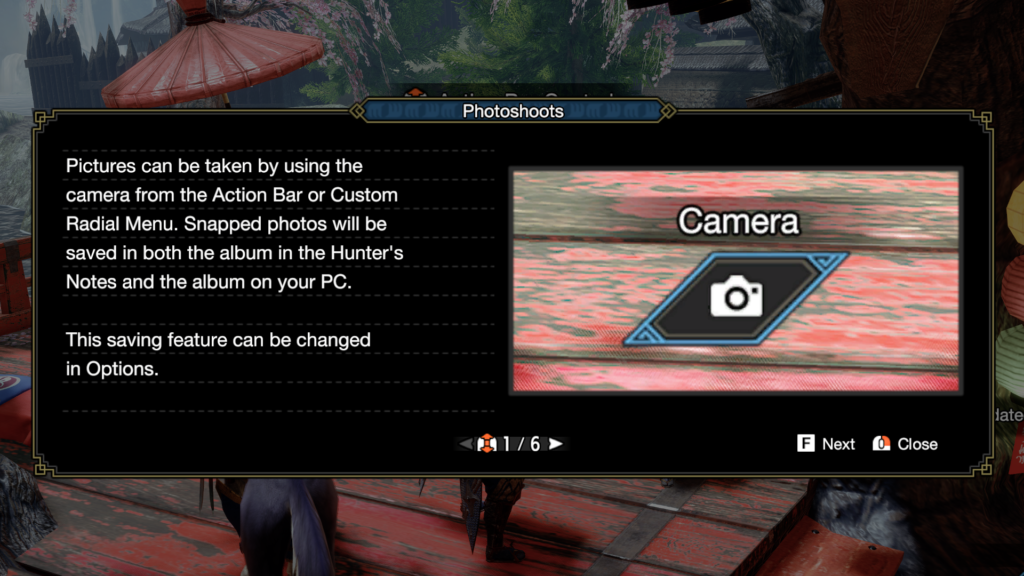
My first impression of Rise was fairly overwhelming. The game introduces an eye-watering number of RPG subsystems to you at a pretty rapid pace and expects you to read tutorial pop-ups for them immediately. These tutorial pop-ups never appear again unless you dig through the menu to find them, and the game doesn’t effectively communicate which ones are critically important and which ones aren’t. I’ve since played the earlier entries and realized that Rise is in fact very well tutorialized by the standards of the series, and I think that says more about the onboarding process in the earlier games than it does about Rise.
I mention all of this because Rise’s position as an entry point is vital to what it’s trying to achieve. I think that Rise is one of the best entries in the series; it’s not an amazing Third or Fourth Monster Hunter Game, but it’s the single best First Monster Hunter Game, and I think that makes it extremely valuable. It’s not a perfect First Monster Hunter Game, though, and it’s important to acknowledge that. For all the steps that Rise makes towards being approachable and welcoming, it still falls short in a number of ways, jeopardizing its role as an effective entry point.
I was able to push through the tutorial vomit. I was able to push through my confusion about how quests and progression worked. I was able to push through the introductory gathering and small monster quests that still feel like a waste of time, even if there aren’t as many as there used to be. Not everyone will be able to push through those things, though, and that’s a tragedy. Rise would be a better game without them. If you’re someone who dropped the game as a result of these hurdles, I implore you to give it a second chance with my promise that it improves dramatically once you’re past them.
With that being said, what makes Rise such an effective entry point is that it delivers an easier and substantially less punishing iteration of Monster Hunter’s core combat than is present in the earlier entries, and it does so without upending the fundamental ideas that make it unique.
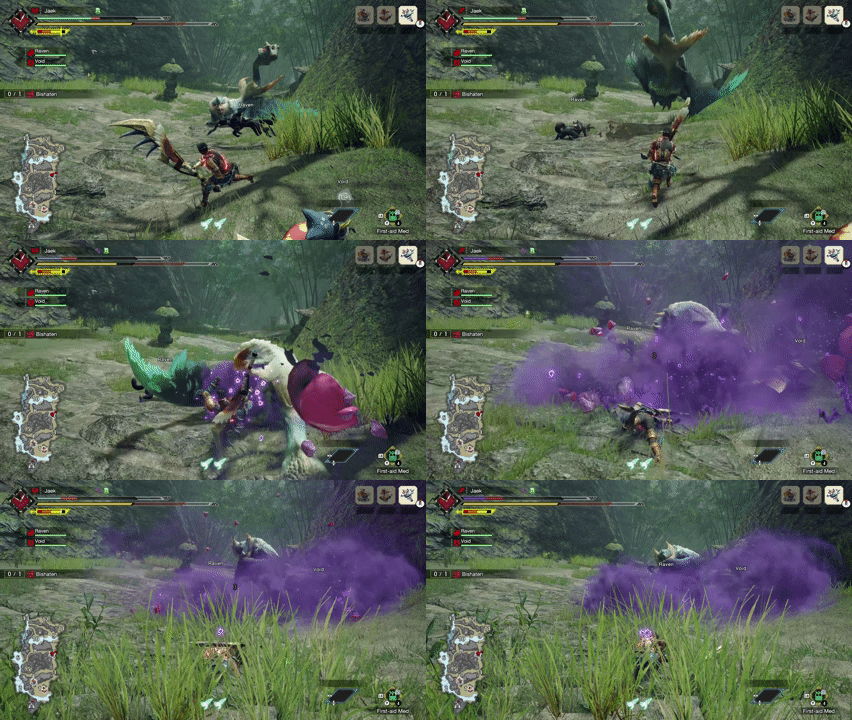
Nearly everything that I love in Monster Hunter 3, 4, Generations, or World is present here. Your attacks are highly committal and cannot be cancelled until near the end of their animations, and with a few exceptions, they can’t be redirected after the initial input. Monsters have a number of “parts” that can be individually targeted and broken, and cause different effects when broken and different amounts of damage when hit. Only a few weapons have on-demand defensive options, and your dodge roll has very few invincibility frames, so you’re encouraged to position intelligently around most enemy attacks instead of being able to simply negate them with a single button press. Weapon movesets are highly diverse, with distinct strengths and weaknesses, different build priorities, and interesting tradeoffs between one another in damage output, flexibility, speed, and ability to stagger, stun, break parts, or sever tails. If you understand Rise’s combat, you understand the fundamentals of every Monster Hunter game’s combat.
This is critical because Monster Hunter’s combat is excellent. It centers skills and tactics that vanishingly few other 3D action games even make relevant. The vast majority of 3D action games boil down to avoiding attacks with good timing and do not demand good positioning and spacing, they give you a powerful lock-on that removes the need to aim precisely with the left stick, and they let you cancel attacks quickly into defensive options while heavily telegraphing when you’ll want to do so.
It’s very rare, in most modern action games, to find yourself in a situation where your poor tactical choices have made it impossible to avoid damage; there’s almost always an on-demand defensive option available, like a dodge roll or a parry. This doesn’t make them easy, necessarily, because the on-demand option might require very tight timing, or you might have to make a lot of moderately tight timings in a row, or you might have to manage a resource to use it, or the game might deliberately obfuscate the telegraph animations, making them harder to read and to learn.
My intent is not to argue that these other games are bad. I think that timing-based defense tests are valuable, and can be interesting, especially when the threats are dynamic and asynchronous, or when paired with a complex and multi-layered set of offensive tools. They do, however, tend to all test the same kinds of defensive skills. Someone who has only played games like Bloodborne, Elden Ring, Bayonetta, Hades, and God of War would be forgiven for being frustrated upon being asked to play tactically and position well in order to avoid damage. This is where Rise comes in.
Rise’s greatest triumph is that it finds a way to force players to break the habits ingrained in them by other 3D action games without making that process unnecessarily painful. Monster attacks still cannot be negated with timing alone, but their hitboxes are smaller, their telegraphs are longer, and their punish windows are a lot clearer. You still have to commit heavily and make yourself vulnerable in order to attack, but the Wirefall mechanic gets you back into the fight quickly when you’re hit and prevents you from being combo’d unavoidably. Healing is still slow and you’re liable to die if you get reckless, but the maps are smaller and palamutes allow you to get around faster, so dying doesn’t feel as punishing.
Moreover, Rise eliminates a lot of the minor annoying shit that sometimes puts players off of the older games. You no longer have to use consumable items (or, in the case of World, run around picking up footprints for a while) in order to track the monster; it’s always displayed on your map. You no longer have to abandon and restart your quest if you forget to eat or refill your item pouch, or discard items permanently if your pouch is full and you want to pick up something else. You no longer have to carry around pickaxes and bug nets that can break upon use. You no longer have to look up weapon upgrade trees, item combos, or monster hitzones and weaknesses online; there’s a very thorough and convenient journal available entirely in-game.
To many fans of classic Monster Hunter, myself included, the inconveniences and difficulties of the older games lend a sense of weight and consequence to your actions that enriches the fantasy of hunting a powerful and dangerous monster. I think there’s value in that, too. I don’t think every future Monster Hunter game should be designed the way that Rise is. I do, however, think that there is space for this type of design in the series, and if it helps newcomers to acclimate to one of the best combat systems in gaming, then I’m okay with an “easy” entry from time to time, so long as the core of what makes the games so special remains intact.
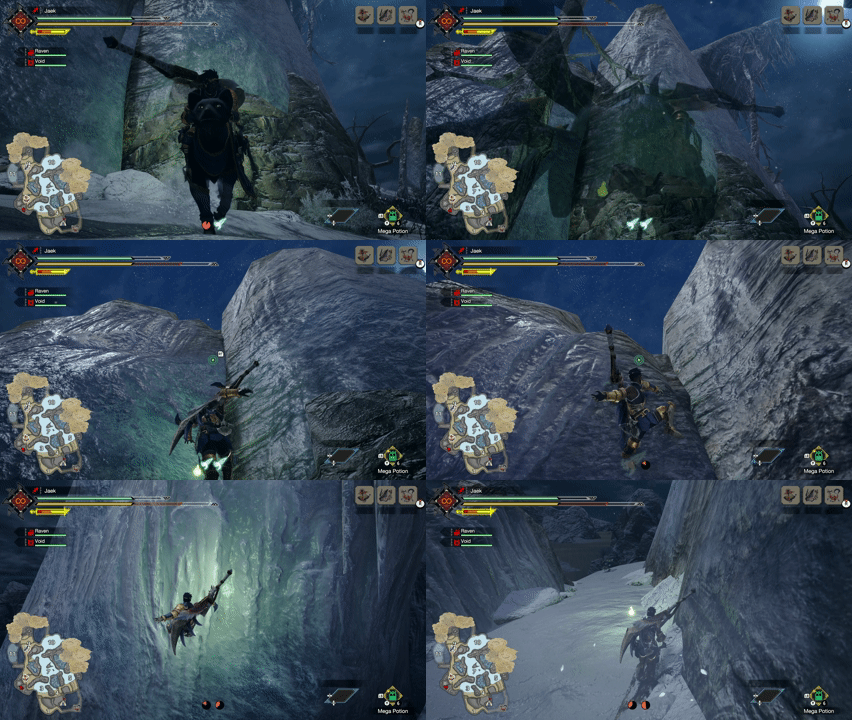
Beyond all of that, I think Rise includes a number of great new additions that are fun to play around with and don’t disrupt the core combat in any way. Palamutes are fun to ride around on. The training area is magnificently fully-featured and enables tons of options for practicing with the various weapon movesets. Wirebug movement makes map exploration a lot of fun, and there are plenty of little secret areas and collectibles to pick up that incentivize mastering it; there’s practically a whole miniature Mario 64-esque collect-’em-up included within Rise. These are largely entirely optional but serve to break up the stress of hunting, which can be oppressive if you’re not used to the ruthlessness of Monster Hunter’s combat.
And that’s really the biggest thing – Rise is definitely easier than previous Monster Hunter games, but it’s not an easy game. It certainly can be easy to veterans of the series, but the average gamer will likely struggle a lot throughout their playthrough, because the rules that Monster Hunter plays by are inherently unintuitive.
That’s not to say Rise’s changes never feel like concessions, or that it’s wholly without abject design flaws. The wirebug skills that Rise introduces for each weapon are rarely all that useful because Wirefall is so strong that, unless you’re good enough to never get hit at all, you usually want to save your wirebugs for it. The changes to Hunting Horn severely reduce the weapon’s depth, and I think there were ways that the barrier of entry could have been lowered without annihilating the skill ceiling. I also think that the movesets of later monsters in High Rank and the endgame could have been made more involved, rather than just cranking up their damage output. The rampage missions are thematic, but so disconnected from the core of the game that they can feel like a waste of time, and there are far too many of them.
The game also inherits some of the flaws of its immediate predecessor, Monster Hunter World. There’s a tendency in both games for monsters to move around ambiently, even between attacks. This ambiguates the monsters’ hurtboxes, making it very difficult to predict exactly where their weak points are going to be when your attack lands. Their AI also feels somewhat less deterministic in comparison to monsters in the older games, which can reduce the impact of proactive positioning as you become more familiar with the monsters’ patterns. On a personal note, I think that the shift to contiguous maps removes the sense of implied scale from the older games’ segregated zones, though the lack of loading screens helps somewhat to make up for the loss.
I think it’s important for an “entry-level” game to not shy away from what makes its series unique and complex. Instead, it should extend a particular amount of grace and forgiveness in response to failure, without removing failure states altogether. Rise may not be the picture-perfect model of this, but it’s a damn good attempt. In spite of its flaws, it’s thoroughly successful in achieving its goals, and it’s a hell of a good introduction to one of the medium’s finest series.